08/10/2026

Vigenin: Health security to be a protected priority in the EU budget
21/11/2025
Vigenin and Penkova with a new Black Sea Office as a link with the region
23/11/2025Vigenin: Health security to be a protected priority in the EU budget
21/11/2025Vigenin and Penkova with a new Black Sea Office as a link with the region
23/11/2025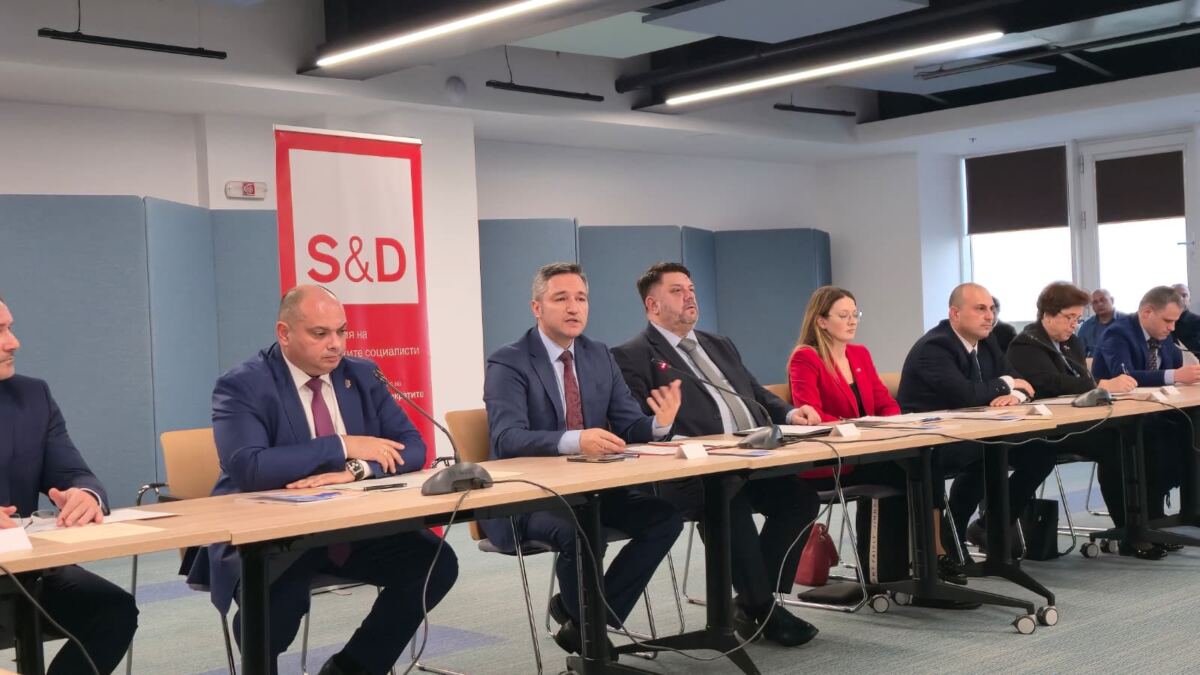
Vigenin and Penkova: The Black Sea should become a strategic priority in European policy
A discussion in Burgas put the focus on the region's security, connectivity and sustainable development
Against the background of the changing geopolitical environment and the need for the European Union to build a new strategic architecture of security and connectivity, the members of the Delegation of Bulgarian Socialists in the European Parliament, Kristian Vigenin and Tsvetelina Penkova, organised a discussion on the future of the Black Sea region.
The event, devoted to the topic “Bulgaria, an active partner in the European strategy for a secure and sustainable Black Sea”, was opened by the Deputy Prime Minister of the Republic of Bulgaria Atanas Zafirov. He stressed the need for Bulgaria to formulate its own doctrine for the future of the Black Sea region: “The war in Ukraine raised very important questions about the future of the region. Its stability was threatened and the dynamics of the processes effectively halted. Today we are in a situation where we face the question of whether and how we can restore relations in the Black Sea region and whether we can think about it in a wider time perspective. This is where Bulgaria should formulate its own doctrine for developing relations with the countries of the region, one that clearly shows that we have not given up on the problems, but have a vision of what to do when this war, sooner or later, ends.” According to Zafirov it is precisely after the end of the war that the Black Sea will become an even more strategic place, and there is no room for delay in shaping such a policy.
The head of the Delegation of Bulgarian Socialists in the European Parliament Kristian Vigenin said that the discussion aims to answer the question of how Bulgaria can play a leading role in shaping European policies that guarantee stability, economic connectivity and energy security in the Black Sea basin. He called for European policy on the Black Sea to become larger in scale, more concrete and more visible. The MEP emphasised the need for real European solutions: “The Black Sea has to be recognised as a sea that deserves attention and effort. We are working to make European policy broader and more comprehensive. The path from the Black Sea Synergy in 2007 to the new strategy shows how much conditions have changed: war, annexation of territories, geopolitical fractures. The EU is starting to think in a new way, and we have a duty to put forward real solutions for security, economic connectivity, transport corridors and environmental sustainability.” He added: “Our commitment is for the Black Sea to be not only a geographical notion, but a clear priority for the EU.”

MEP Tsvetelina Penkova called for: “Let us turn geography into strategy, and strategy into results for people.” She stressed that the Black Sea already occupies a central place on the European energy and industrial map: “The region is a strategic pillar in the EU’s new architecture. Investment is needed in maritime security, modern energy corridors and protection of underwater infrastructure. Bulgaria can be a connecting hub, from underwater power lines and digital networks to future hydrogen routes and CO2 infrastructure.” Penkova believes Bulgaria’s leading role is not symbolic, but a real responsibility: “We have to set the direction in Europe, stand up for key projects and be a driver, not an observer in the process.” Penkova recalled that the ANRAV project (in Devnya) is the first complex project in Eastern Europe for capturing, using and storing carbon dioxide. “This demonstrates Bulgaria’s potential to be a leader in the region when we talk about industrial growth and new technologies,” the MEP added.
“The EU’s new strategic approach for the Black Sea region opens up key opportunities for Bulgaria and the region,” said Deputy Minister of Foreign Affairs Nikolay Berievski. He stressed that the strategic importance of the Black Sea region is determined by its geographical position as a bridge between Europe and Asia. Berievski recalled that Bulgaria and Romania initiated the development of a European strategy for the Black Sea, on the basis of which work on the EU’s new strategic approach began in 2024. “The importance of trans-European corridor No 8 is strategic not only for connectivity, but also for military mobility within NATO. Bulgaria is working actively with the countries in the project to speed up its delivery. Coordinated efforts are needed between the Bulgarian institutions, the EU member states, the NATO partners, the international financial institutions and private investors,” Berievski concluded.
Deputy Minister of Regional Development and Public Works Dora Yankova outlined key infrastructure priorities, from Corridor No 8 and the “Black Sea” motorway to Ruse – Veliko Tarnovo and the link to the Aegean Sea. “Bulgaria is already a key factor in regional connectivity. These projects will relieve traffic, improve logistics and confirm our role as a stable transit centre,” she noted.
The forum was also attended by Deputy Minister of the Interior Filip Popov, the chair of the Committee on Economic Policy and Innovation
in the National Assembly and head of the Bulgarian delegation to PABSEC Petar Kanev, Prof. Marusya Lyubcheva, founder of the Black Sea Institute in Burgas, representatives of the Port of Burgas, mayors, regional governors and experts from various professional fields.
The discussion outlined the specific areas in which Bulgaria has to work actively in the EU’s upcoming strategic period. The participants united around the need for the country to play a leading role in shaping European policies for the Black Sea.
With their initiative Vigenin and Penkova established the Black Sea as their European priority and asserted Bulgaria’s leading role in this process.
More News
07/10/2026