19/10/2026

Vigenin on Sarafov’s resignation: A different wind is blowing, but real judicial reform is yet to come
28/05/2026
Zarkov, Vigenin and Penkova in Yambol: Water sector reform and infrastructure investment cannot be postponed
29/05/2026Vigenin on Sarafov’s resignation: A different wind is blowing, but real judicial reform is yet to come
28/05/2026Zarkov, Vigenin and Penkova in Yambol: Water sector reform and infrastructure investment cannot be postponed
29/05/2026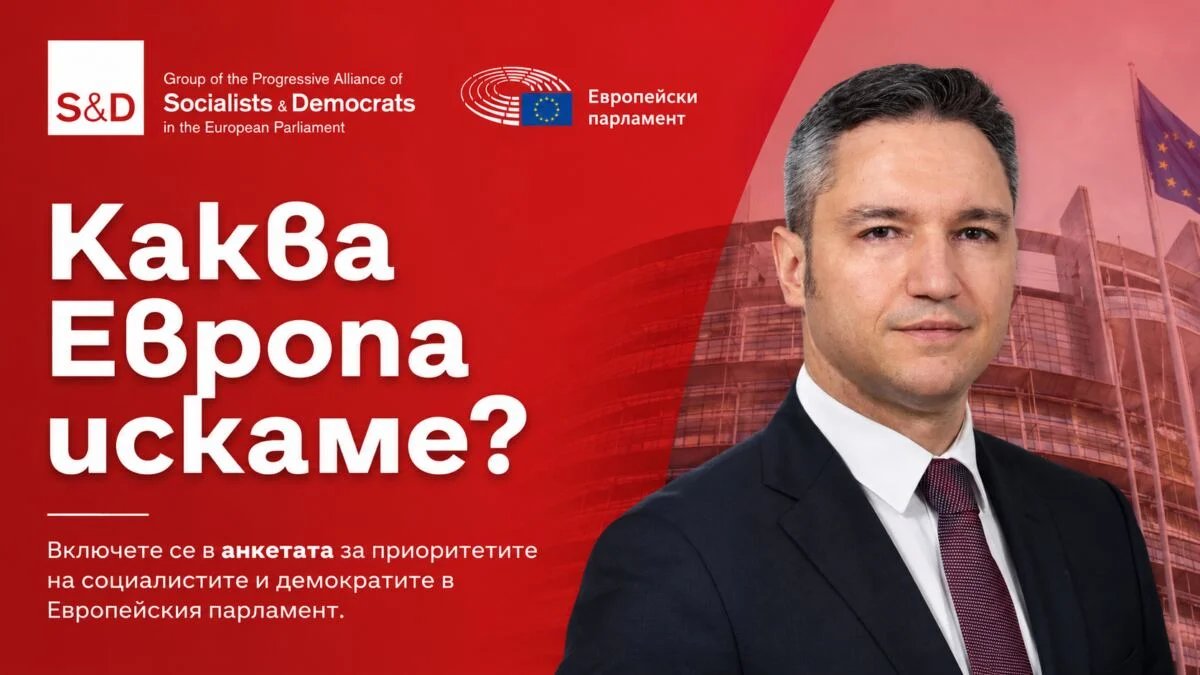
What kind of Europe do we want?
Take part in the survey on the priorities of the Group of the Socialists and Democrats in the European Parliament
The Group of the Socialists and Democrats in the European Parliament has started work on setting its main priorities until the end of the term. After extensive internal discussions in committees and working groups, the socialist MEPs selected 15 topics, which they are now putting to an internal consultation.
Each of us has to choose 6 topics, and those with the highest score will be the focus of the Socialists’ policy from now on.
I am asking you to help me decide together which six topics to support. To make the process easier, I first chose 12 of the 15 proposed.
By Sunday, 31 May, please vote for 6 of these 12.
On Monday I will cast my vote in the Group in the order you have ranked them.
Below you can find more information on each of the topics included in the survey.
Fill in the survey here: [LINK TO THE SURVEY]
Information on the topics:
Topic 1 – Affordable housing:
Housing is a fundamental right, not a financial asset. Europe must treat housing as a social necessity rather than a market commodity, while giving cities and Member States the legal and financial capacity they need to tackle the housing crisis.
This initiative will push for legislation on short-term rentals that protects cities and citizens from the uncontrolled spread of such practices, and for the creation of a EUR 100 billion European fund under the next Multiannual Financial Framework after 2028. The money will go to building and renovating affordable, energy-efficient and social housing, especially for low- and middle-income households, young people and vulnerable groups.
Topic 2 – Clean energy at fair prices:
If the EU’s dependence on energy imports is not reduced as quickly as possible, European citizens will continue to face even higher energy bills and serious financial hardship. Renewable energy produced in Europe must become a top priority in order to reduce both the cost of living and the cost of doing business in Europe.
This flagship initiative will push for faster electrification of heating and transport through social leasing schemes, a review of electricity market rules so that consumers can fully benefit from cheap renewable energy, and the introduction of an EU-level windfall tax on the oil and gas sector, with the revenue going directly to support households.
The initiative will also promote the decarbonisation of industry, particularly SMEs, public and cooperative investment in renewable energy, power grids and energy storage, and the creation of an Industrial Decarbonisation Bank to channel a larger share of Emissions Trading System (ETS) revenue directly and exclusively into transformative investment in industrial decarbonisation.
Topic 3 – A quality jobs programme for all:
This flagship initiative will turn the urgent need to improve working and living conditions for all into concrete action and practical results.
For the S&D Group, Europe’s competitiveness is built on a strong social Europe: skilled workers, fair pay, collective bargaining, secure employment and safe working conditions.
The initiative will push for ambitious legislation on the right to disconnect, fair rules on telework, regulated algorithmic management and use of artificial intelligence in the workplace, better integration of workers, and particularly women, into the labour market, a European Care Deal, measures to tackle mental health at work and action against exploitative subcontracting chains.
Topic 4 – Affordable high-quality food for all Europeans:
Europe cannot accept a situation where 8.5% of its population cannot afford a proper meal every second day. No one in Europe should go hungry.
This initiative aims to guarantee affordable, high-quality food for all, while strengthening European food sovereignty, reducing external dependencies and ensuring fair incomes and resilience for farmers, fishers and aquaculture producers. It envisages promoting sustainable agriculture and fisheries through stronger local value chains, shorter supply chains, healthier food standards and better public procurement for schools, hospitals and canteens.
The main measures include adopting a European Food Sovereignty Act, strengthening market stability through future reforms of the Common Agricultural Policy (CAP), introducing a “blue” label, the “Blue Food Sustainable Label”, to support sustainable seafood production, and increasing support for food banks to fight food poverty.
At the same time, the initiative aims to reduce external dependencies by promoting sustainable production, decarbonising the fishing fleet and strengthening protection against unfair imports and illegal fishing.
Topic 5 – Youth package:
Meaningful participation of young people and social inclusion are fundamental pillars of democratic societies and a precondition for inclusive, sustainable and future-oriented policymaking.
Today young people still face many obstacles to taking part in decisions that affect their own future. The youth perspective needs to be built into all policy areas, and young people’s active participation in shaping Europe’s future needs to be encouraged.
This flagship initiative will push for a ban on unpaid internships, full and systematic application of the Youth Check in all EU legislation and programmes, and a free cinema ticket to watch a European film on Europe Day (9 May) for all young Europeans under 30.
Topic 6 – Affordable rail travel:
Rail should be the backbone of clean and connected mobility in Europe, but it is still too expensive, fragmented and difficult to use. Passengers should be able to rely on simple, transparent and fully integrated rail services across operators and countries. Unlocking rail’s full potential and making it more price-competitive is important for delivering a green and socially fair transition in transport.
This initiative will promote a modern and accessible EU online booking system for rail travel and guarantee seamless rail passenger rights across Europe. It will also push for a range of EU-level actions to directly reduce the cost of rail travel, including a VAT exemption for international rail passenger transport, investment in high-speed rail accessible to all categories of passengers, and reform of infrastructure charges.
Topic 7 – A European Defence Union, EU industrial sovereignty and peace:
By aligning industrial policy, defence planning and regulatory frameworks at EU level, this initiative will create a more coherent, competitive and resilient Union, able to protect its citizens, preserve peace and support quality jobs and technological leadership while safeguarding the European social model.
Integrated European defence: building a genuine European defence market through coordinated planning, shared industrial priorities and common rules to strengthen sovereignty and preparedness, including through cooperation with Ukraine and by integrating valuable Ukrainian defence experience into Europe’s collective security efforts.
A comprehensive approach: promoting a whole-of-society approach, recognising that defence, social cohesion and public services are equally important for security and peace.
Priority for European projects in public procurement: prioritising joint European procurement and strengthening the European defence industry, while guaranteeing fair opportunities for companies of all sizes.
Workers at the centre: investing in skills, training and quality jobs in the defence sector, and linking European defence funding to social standards and balanced regional development.
Topic 8 – Curbing the influence of big tech companies:
To deliver on the promise of digital fairness, stronger online protection and restoring Europe’s digital sovereignty, we must curb the influence of big tech companies.
This flagship initiative will push for four interlinked goals.
First, taxing big tech companies and their billionaire owners.
Second, effective enforcement of existing digital rules and the adoption of a new Digital Fairness Act (DFA) to counter addictive design, so-called “dark patterns” and unfair personalised and dynamic pricing more effectively. The initiative also aims to protect minors and all citizens from harmful online practices, create additional data rights for citizens and workers and limit the use of targeted advertising.
Third, reducing Europe’s technological dependence by creating trustworthy European platforms, sovereign and sustainable cloud services, artificial intelligence (AI) and data infrastructure.
Fourth, protecting democracy from polarising social media algorithms and protecting elections from foreign interference, disinformation and hybrid attacks.
Topic 9 – Clean and safe water:
Water is essential for life, for functioning ecosystems, for the health of the planet, for economic competitiveness and for society as a whole. Yet the state of Europe’s waters is a cause for serious concern because of chemical pollution from a variety of sources, and in particular contamination with so-called “forever chemicals” (PFAS) in drinking water sources, rivers, soils and living organisms in the EU.
Water is a fundamental right that must be protected through a comprehensive approach, from source to sea, and preserved for future generations.
This flagship initiative will push for concrete action on so-called “forever chemicals” (PFAS) and the pollution they cause, in order to protect health and the environment, and will oppose attempts to weaken or roll back existing water legislation, including the upcoming review of the Water Framework Directive.
The initiative will also push for binding sectoral targets for water efficiency and water use in agriculture, industry and households, based on river basin assessments, full implementation of existing EU water legislation, and the adoption of a European Ocean Act with concrete and binding targets for the effective protection of ocean biodiversity.
Topic 10 – Trade on EU terms: high standards, more jobs, lower bills:
This flagship initiative would launch an ambitious campaign on EU-US trade relations and on cutting unnecessary tariffs in strategic sectors, lowering costs for households and SMEs, ensuring resilient supply chains and promoting sustainable economic growth.
It would offer a clear alternative to the inflationary logic of tariff nationalism and economic confrontation associated with Donald Trump’s administration.
The aim is to build a broad progressive transatlantic coalition that turns tariff cuts into a practical response to the cost-of-living crisis, while protecting workers’ rights, environmental standards and Europe’s strategic autonomy.
There is a clear political dividing line here: where nationalists impose tariffs that raise prices, progressives lower bills through cooperation. Where protectionism creates uncertainty, progressive policies create jobs and investment. Where Trumpism uses trade conflicts as a political weapon, progressives use trade to improve people’s everyday lives.
Topic 11 – A strong EU4Health programme:
Too many Europeans keep getting ill because unhealthy environments, harmful products, tobacco use, poor working and living conditions and social inequalities affect their health long before treatment begins.
This flagship initiative proposes a shift from a healthcare model focused mainly on treatment to one based on prevention, by guaranteeing a strengthened and clearly recognisable EU4Health programme in the next Multiannual Financial Framework (MFF). The aim is to fund a strong European prevention plan, including a mental health plan and a women’s health strategy, and to introduce a horizontal “Prevention first” principle in all health-related EU legislation through a European Prevention Plan.
The initiative also provides for the long-term continuation of Europe’s Beating Cancer Plan and the Safe Hearts Plan.
Topic 12 – A civic space guarantee:
Civil society organisations are essential for protecting democracy, fundamental rights and European sovereignty. They act as a public watchdog, promote media literacy, counter disinformation and ensure that citizens’ voices are represented in EU decision-making alongside corporate interests.
A strong civic space guarantee would help protect these organisations equally in all Member States, strengthening the EU’s resilience, unity and independence in the face of authoritarian pressure and preventing politically motivated attacks aimed at undermining democratic participation and access to European resources and funding.
More
News
18/10/2026